
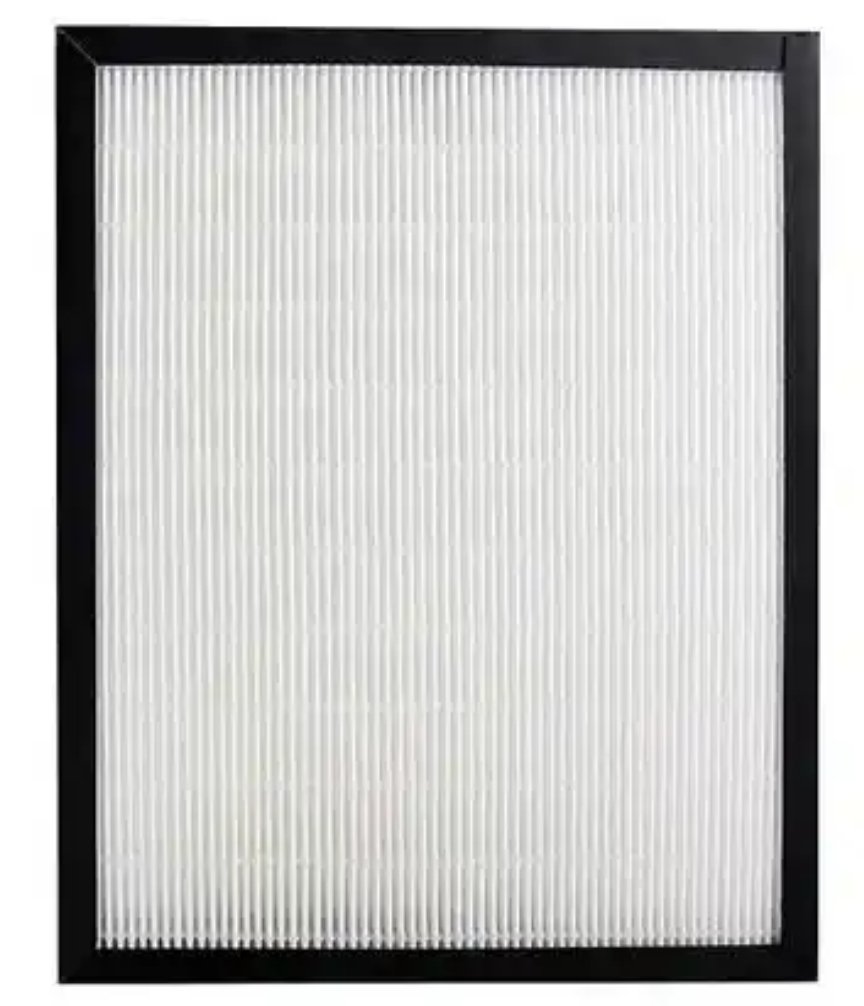
HEPA Selection Is Fine — So Why Does It Still Fail Inspection?

A practical look at why “perfect” cleanroom filter design still runs into re-tests and non-conformances on site.
In cleanroom projects, there is a very common confusion:
During design, the combination of pre-filters, medium filters, sub-HEPA, HEPA, and even ULPA is carefully calculated. Air volume, resistance, efficiency class, and MPPS are all worked out. Drawings are reviewed. Suppliers are selected and qualified.
Then the project lands on site, and during cleanroom filter testing:
- HEPA filter leak tests fail and need re-testing;
- Some points show low particle counting efficiency and are marked non-conforming;
- After replacement, re-testing barely passes;
- The schedule slips, and the acceptance milestone gets pushed back.
Where does the problem actually come from?
Let’s start with one chart.
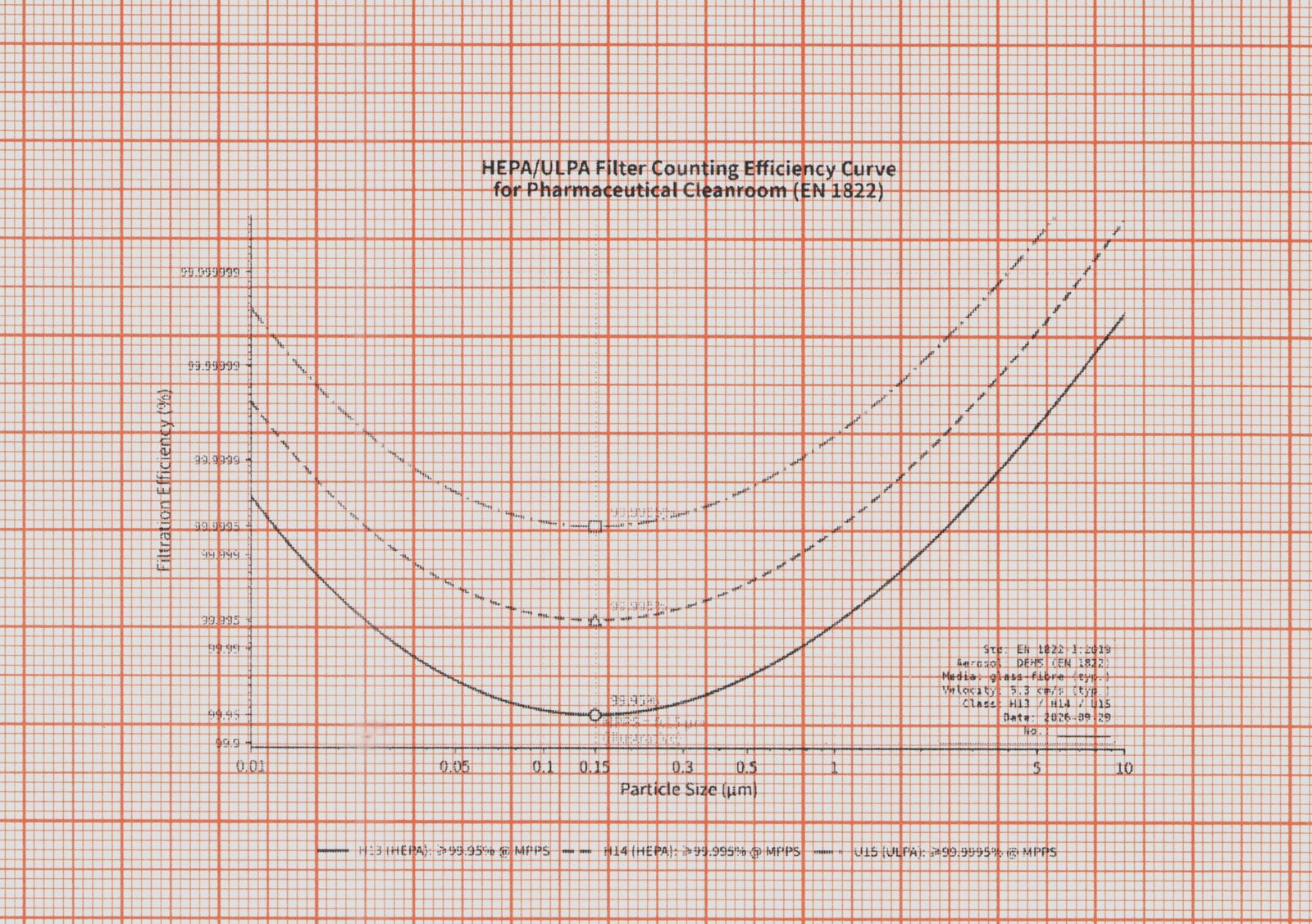
This chart shows how counting efficiency changes with particle size for H13, H14, and U15 filters under EN 1822. The lowest point of efficiency is around the Most Penetrating Particle Size (MPPS) — and that is exactly the range where on-site HEPA filter inspection focuses.
1. “Perfect” at design stage is perfect under theoretical conditions
At design stage, we usually base everything on:
- Standard airflow;
- Design air change rate;
- Rated filter efficiency (H13/H14/U15);
- System resistance balance;
- Reasonable pre-filter, medium filter, and sub-HEPA staging.
This logic is not wrong. The problem is that it is system-level perfection, not unit-level perfection.
Design calculates the combined efficiency of the whole filter chain. On-site testing measures:
- The integrity of a single HEPA filter;
- The sealing after installation;
- Frames, glue lines, gaskets, static box connections;
- And actual efficiency under real operating airflow.
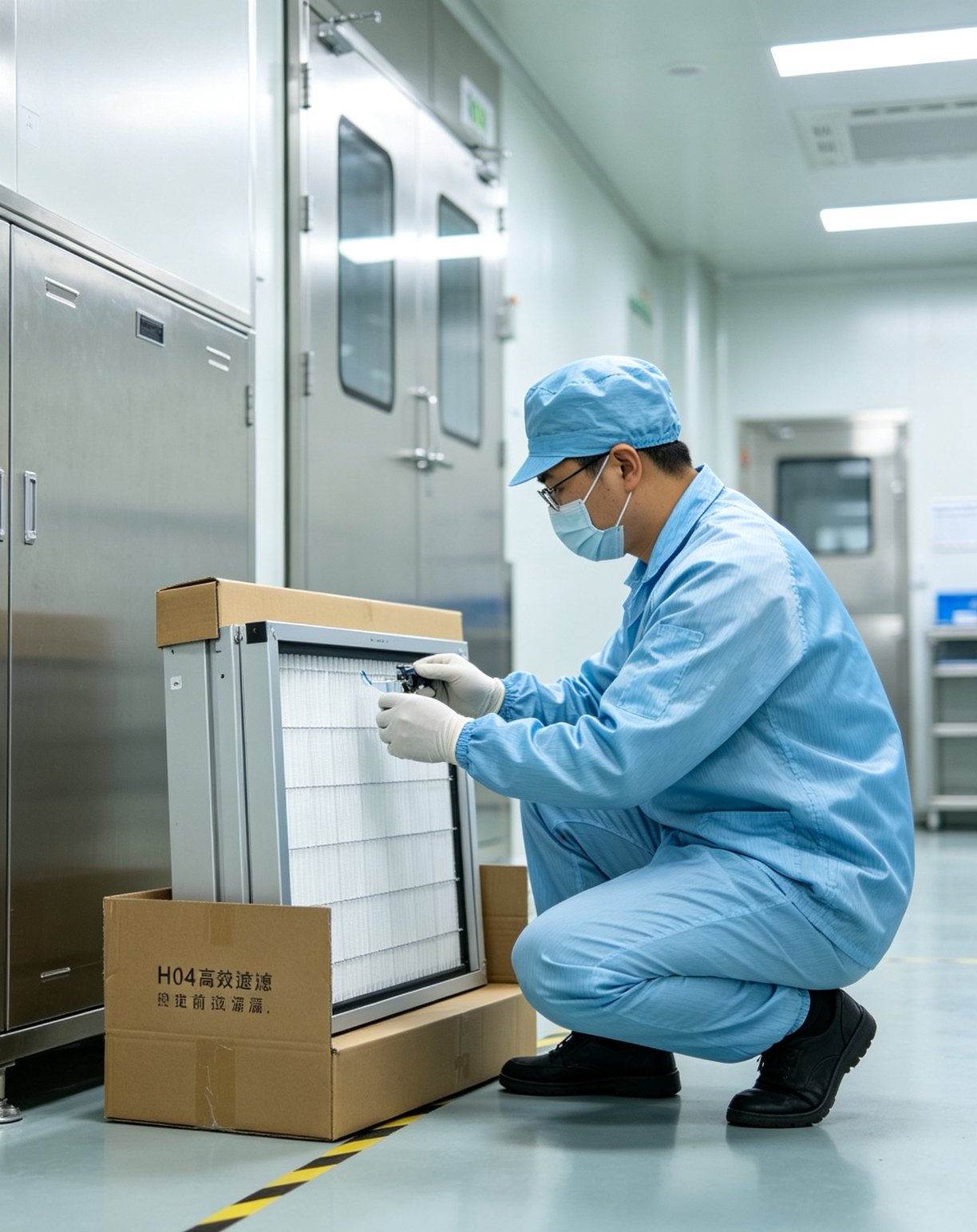
Unboxing inspection and on-site leak testing do not test “design efficiency.” They test manufacturing consistency + transport integrity + installation sealing.
2. A qualified product does not guarantee a passed on-site test
Even for HEPA/ULPA products from reputable manufacturers, problems can still appear at these stages:
1. Batch variation in filter media
The same model and efficiency class can vary slightly in MPPS efficiency between batches. Passing at the factory does not mean it stays optimal under site conditions.
2. Transport and handling damage
Folded media damage, glue line cracks, frame deformation — often invisible to the eye, but a leak detector will catch it immediately.
3. Installation sealing failure
This is one of the most common causes of on-site failure. Liquid seal, gasket, compression bolts, static box welds — any detail done poorly can cause local leakage.
4. Actual airflow differs from design airflow
HEPA efficiency is related to airflow. When actual operating airflow deviates from the rated value, efficiency around MPPS can also shift.
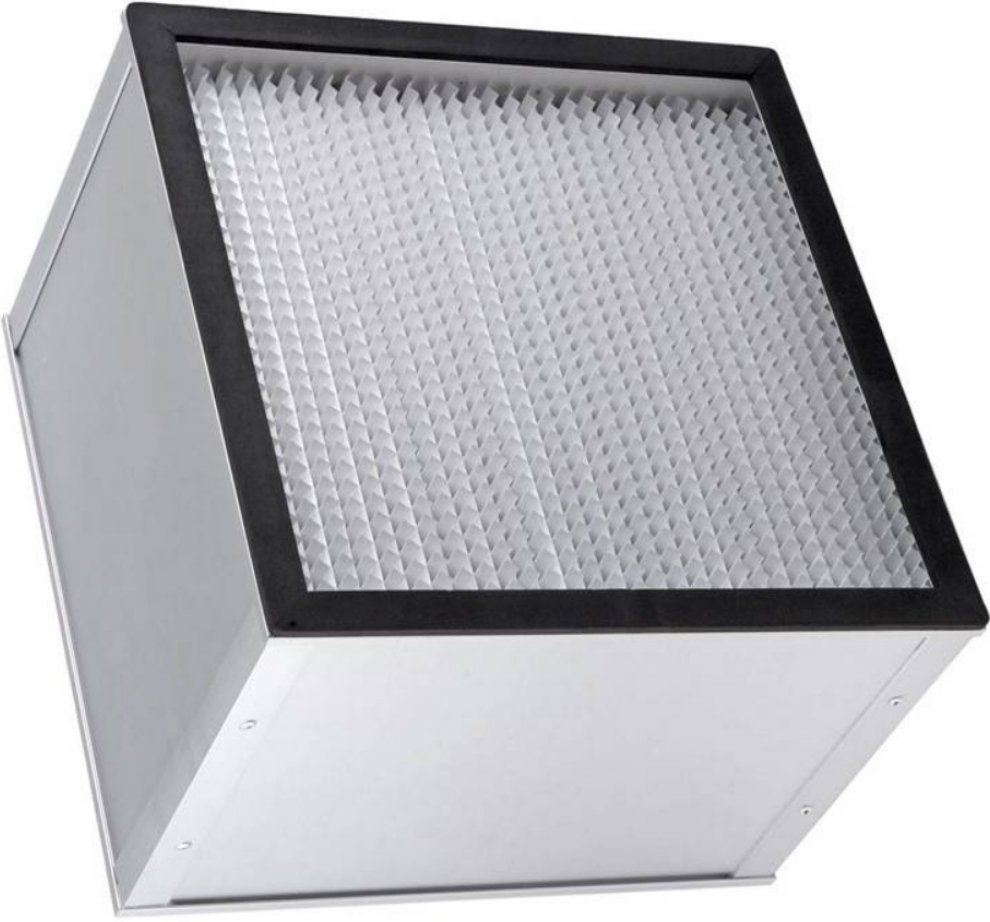
ULPA has higher filtration efficiency, but it is also more sensitive to installation sealing and testing conditions. The higher the efficiency, the lower the tolerance for details.
HEPA is the core final barrier in a cleanroom, but it does not work alone. The pre-filter, medium filter, and sub-HEPA in front of it determine the actual load and service life it experiences.
3. Why does a “perfect” pre-filter combination still fail?
Because that combination solves:
- Extending HEPA service life;
- Reducing system resistance growth;
- Controlling large particle load.
But it does not solve:
- Manufacturing and installation deviations of the HEPA itself;
- Airflow uniformity during on-site testing;
- Standardization of scan leak testing;
- Sealing quality between frame and static box;
- Deviations in test instruments and methods.
In other words:
Pre-filter staging protects the HEPA.
On-site testing examines the HEPA itself and the installation itself.
These are two different dimensions.
4. Re-testing and non-conformance are not necessarily bad
From a project management perspective, re-tests and failures do delay the schedule and increase cost. But from a quality perspective, they are the last line of defense.
If on-site testing “passes everything on the first try,” it is actually worth asking:
- Is the test method compliant?
- Was the scan complete?
- Was the instrument calibrated?
- Was it just a formality?
A truly rigorous project is not one with zero re-tests. It is one where every re-test has a reason, every correction has a closed loop, and every re-measurement has a basis.
5. Suggestions for the early project stage
- Leave efficiency margin in selection — do not select right at the standard lower limit.
- Put installation sealing into the construction briefing — do not assume “the workers will do it right.”
- Move unboxing inspection earlier — do not wait until installation to find problems.
- Confirm the leak test plan in advance — including scan method, instruments, and acceptance criteria.
- Write the re-test mechanism into the contract — clarify responsibilities and schedule buffer.
- Keep test records — as the basis for acceptance and future O&M.
Conclusion
A HEPA/ULPA efficiency curve shows a theoretical trend.
An on-site leak test measures engineering reality.
A “perfect” design combination solves system logic.
Re-tests and non-conformances during execution expose the combined errors of manufacturing, transport, installation, and testing.
Filter selection can be perfect, but project execution always needs room for verification and correction.
A truly professional cleanroom project is not one that never re-tests. It is one where every re-test has a cause, and every correction has a closed loop.