
Who Leaks Particles? 5 Lab Tests to Choose the Right Filter Combination for High-Class Cleanrooms

In high-class cleanrooms (such as pharmaceutical facilities and biosafety labs) and precision electronics manufacturing (like display panels and chip packaging), the “Pre-filter + Medium filter + HEPA” multi-stage filtration system is the standard.
However, engineers often face a dilemma:
- If the terminal filter is H13, should the pre-filter be G4+F7 or G4+F7+F9?
- Since the terminal efficiency is the same, how much difference do different combinations actually make? Is adding extra pre-filtration really necessary?
To find the answer, we conducted comparative tests of 5 different combinations across 5 laboratories and plotted this highly valuable curve graph.
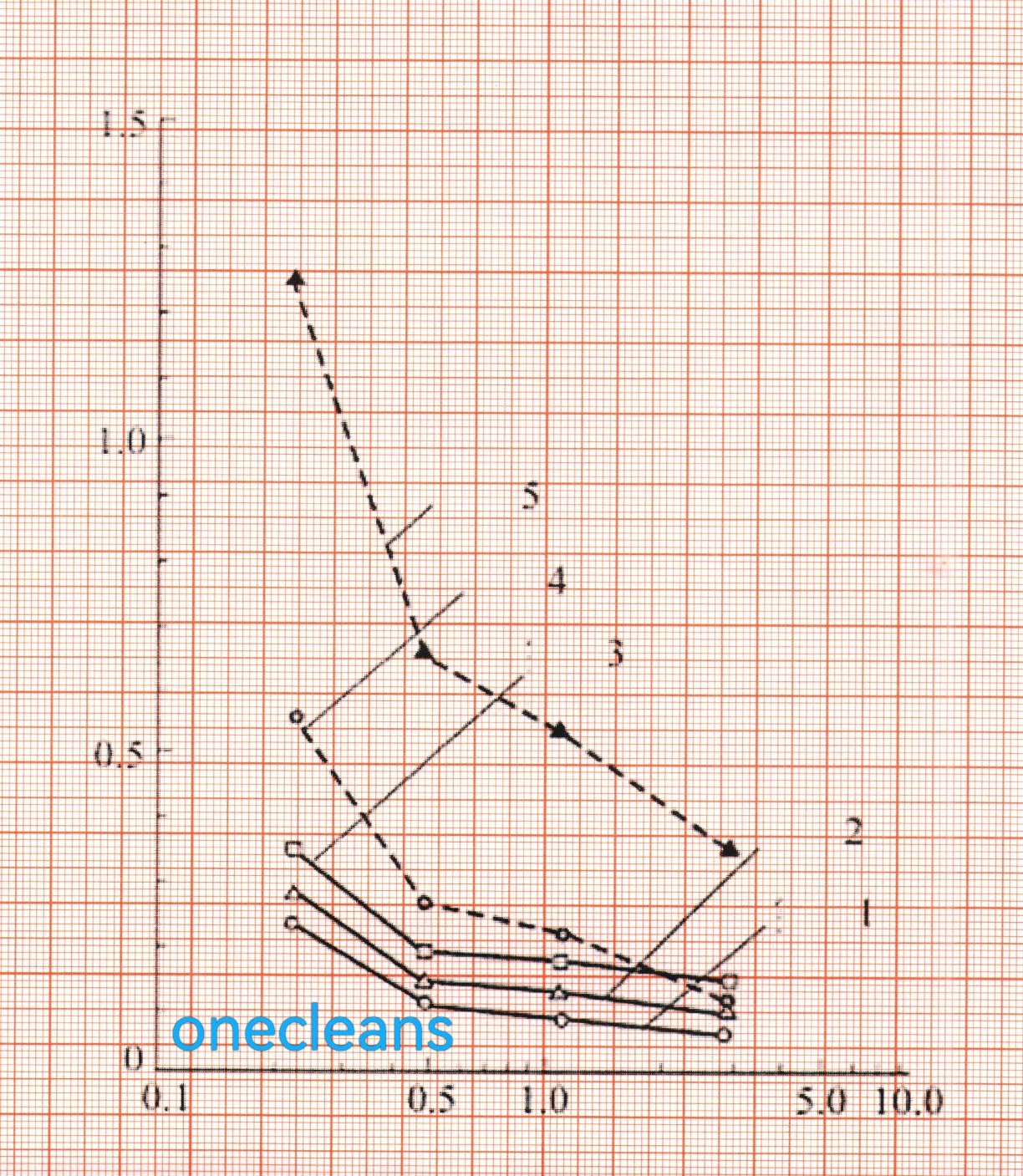
Note: The X-axis represents particle size (0.1μm~10.0μm), and the Y-axis represents penetration rate (lower is better). Please specify the 1-5 combination details.
01 The Core of the Graph: Why Focus on 0.3μm?
As you can see, the X-axis extends from 0.1μm to 10.0μm. In standard HEPA (like H13) classifications, the test baseline is typically set around 0.3μm (the Most Penetrating Particle Size, MPPS).
Looking at the bottom three solid lines (representing combinations ending with H13), even at this most penetrating “blind spot” around 0.3μm, the penetration rates are pressed to the bottom. The corresponding filtration efficiency reaches an astonishing 99.995% or higher. This proves that as long as the terminal filter is a qualified HEPA (H13 or above), the final air cleanliness is guaranteed.
02 Why Add F9 If the Final Efficiency is the Same?
If we only look at the final air cleanliness, G4+F7+H13 and G4+F7+F9+H13 are indeed very similar. However, from an operational perspective, the difference is huge:
- Protect Expensive Terminal Filters: In the 0.1~1.0μm range, F9 has an extremely strong interception capability. Adding an F9 acts as a “bulletproof vest” for the terminal H13, capturing the vast majority of fine particles in advance. This slows down the pressure drop of the H13 and extends its replacement cycle by 1.5 to 2 times.
- Maintain Stable Airflow: If the pre-filter lacks dust-holding capacity, its resistance will spike, leading to a drop in airflow and fluctuating cleanliness levels. Adding an F9 makes the system more robust against load fluctuations.
If your budget allows and your facility operates 24/7 (like pharma or precision electronics), G4+F7+F9+H13 is the more reliable “Golden Combination.”
03 The Semiconductor Perspective: Where is the Divide?
Some might ask: Since this graph shows such great performance at 0.3μm, can this setup be used for semiconductor fabs? The answer is: No.
Pharma and regular electronics focus on particles above 0.3μm. But for core semiconductor processes (like lithography), the test baseline drops directly to 0.1μm (or smaller).
Look at the far left of the graph at 0.1μm. This is the battlefield for U-series (like U16 ULPA). U16 provides over 99.999% interception at this extreme particle size, which is the ceiling required for semiconductor core areas.
The Divide:
- High-Class Cleanrooms/Regular Electronics: Terminal H13 with G4+F7+F9 is sufficient to achieve perfect interception at 0.3μm.
- Semiconductor Core Areas: Must upgrade the terminal to U16 ULPA, keeping the G4+F7+F9 pre-filter logic, to combat the extreme 0.1μm particles.
04 Conclusion: How to Choose for Your Facility?
Based on our test data, here is a straightforward selection guide:
- Standard Cleanrooms: G4 + F7 + H13. Most cost-effective, meets standard requirements.
- High-Class Cleanrooms (Pharma/Electronics): G4 + F7 + F9 + H13. Strong protection for terminal filters, smoother long-term operation.
- Semiconductor Core Areas (ISO 1~3): G4 + F7 + F9 + U16. Ultra-high efficiency to lock down 0.1μm particles, with F9 as the shield.
Whether you are building a pharma plant or an electronics fab, the essence of filtration is balancing initial investment, energy consumption, replacement costs, and extreme precision.
What is your facility’s operating condition?
Leave a message for One Cleans, and we will customize the most cost-effective filter combination for your specific environment and process requirements!